
12 May 2026 By Shreenivasan V
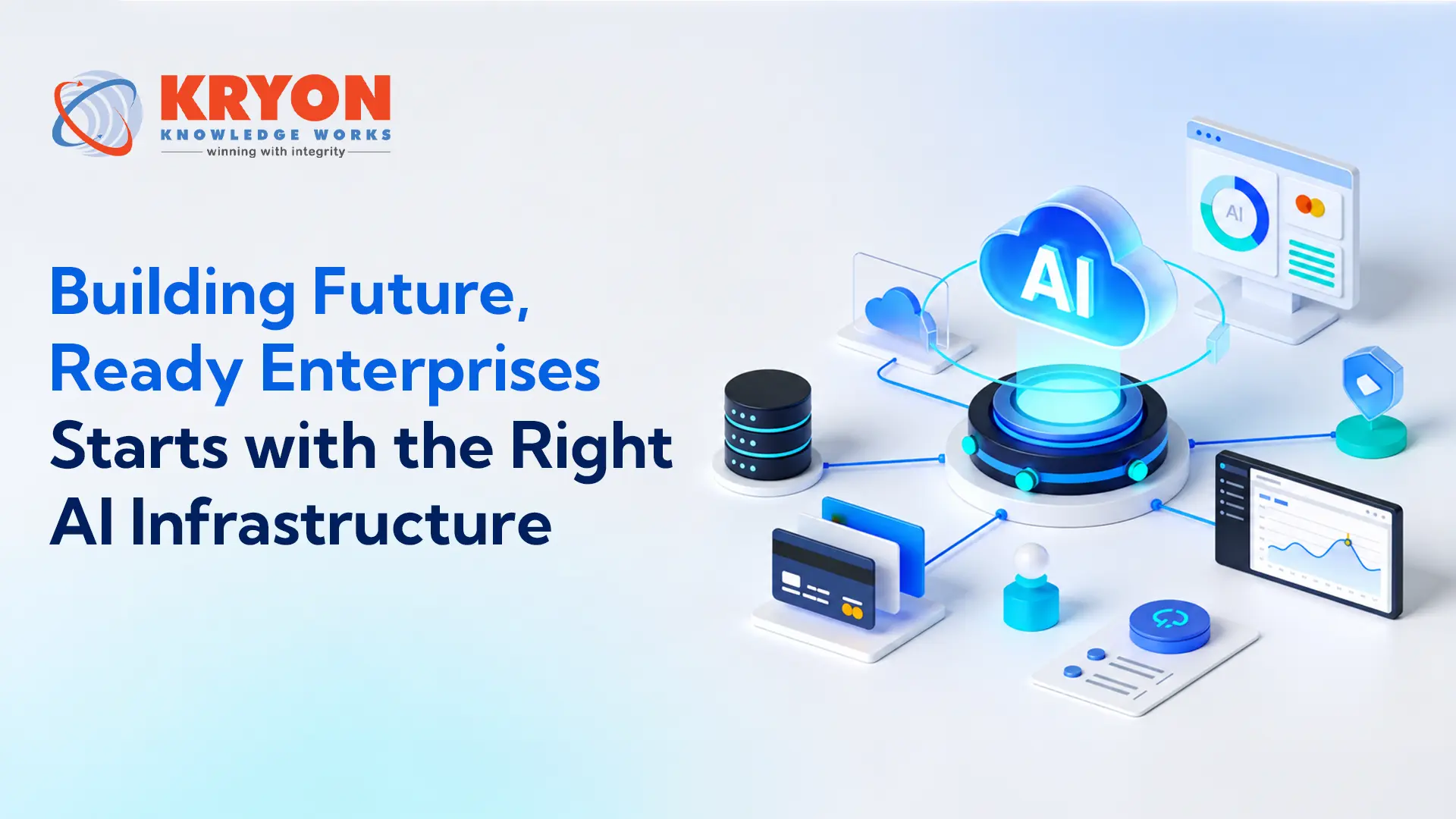
Artificial Intelligence is no longer a future ambition for enterprises. It is becoming a defining force behind how organizations operate, compete, and grow in an increasingly digital economy.
Across industries, business leaders are moving beyond conversations about AI experimentation and beginning to focus on something far more important—how to build enterprises that are intelligent at their core.
While much of the public discussion around AI focuses on models, automation tools, and emerging applications, the real differentiator lies elsewhere. Sustainable AI transformation depends on the infrastructure supporting it.
In many ways, infrastructure has become the silent engine behind enterprise innovation.
Organizations today are under growing pressure to operate faster, make smarter decisions, deliver personalized customer experiences, and respond to market changes with greater agility. Achieving this at scale requires more than adopting AI platforms. It requires building environments where intelligence can function seamlessly, securely, and continuously across the business.
This is why AI infrastructure is no longer just a technology consideration. It has become a strategic business priority.
Over the last decade, enterprises have focused heavily on digital transformation. The objective was to modernize operations, improve connectivity, and create digitally enabled customer experiences.
Today, we are entering the next phase of transformation—the rise of intelligent enterprises.
This shift is fundamentally changing how organizations think about operations, data, leadership, and decision-making. AI is no longer being implemented as a standalone capability. It is becoming deeply integrated into enterprise ecosystems, influencing everything from operational workflows and customer engagement to analytics and strategic planning.
As organizations scale AI adoption, many are realizing that legacy environments are often not equipped to support modern intelligence systems effectively.
Without scalable infrastructure, AI initiatives can quickly become fragmented, difficult to manage, and challenging to expand across the enterprise.
Future-ready organizations are therefore investing in infrastructure that enables:
The enterprises creating long-term impact today are not simply adopting AI. They are redesigning their operational foundations to support continuous intelligence.
One of the most significant developments in enterprise AI is the growing importance of data maturity.
Organizations generate massive volumes of information every day across systems, applications, and customer interactions. However, the true value of data lies not in its volume, but in how effectively it can be transformed into actionable insight.
Modern enterprises are increasingly recognizing that disconnected data environments create limitations not only for AI performance, but for business agility itself.
As a result, organizations are prioritizing intelligent data architectures that enable seamless connectivity across departments and operational functions.
The objective is clear: create environments where information flows efficiently, insights become accessible in real time, and decision-making becomes more predictive rather than reactive.
In today’s AI-driven economy, data infrastructure is no longer just a backend operational component. It is becoming one of the most important strategic assets an enterprise can possess.
The organizations that build strong, scalable, and intelligent data ecosystems today will be significantly better positioned for the future.
The growing scale of AI workloads has also accelerated the shift toward cloud-native infrastructure models.
Traditional systems were designed for stability and long-term predictability. Modern enterprises, however, require environments that can adapt continuously to evolving business and operational demands.
Cloud-native ecosystems provide the flexibility required to scale rapidly, deploy faster, and support innovation without disrupting enterprise continuity.
This is particularly important as organizations expand globally and manage increasingly complex digital ecosystems across multiple markets and operational environments.
We are also seeing increased adoption of hybrid and multi-cloud strategies as enterprises look to balance scalability, compliance, resilience, and operational efficiency.
The future of enterprise infrastructure will be defined by adaptability.
AI technologies will continue evolving rapidly, and organizations need infrastructure capable of evolving alongside them.
As enterprises accelerate AI adoption, conversations around trust, governance, and responsibility are becoming increasingly important.
Organizations today manage highly sensitive operational, financial, and customer data. This places significant responsibility on enterprises to ensure that AI systems remain secure, transparent, and compliant.
Responsible AI is no longer a secondary discussion. It is becoming central to long-term enterprise sustainability.
Building future-ready enterprises means building systems that are:
In my view, organizations that approach AI responsibly will create stronger customer relationships, greater operational resilience, and more sustainable long-term growth.
Technology leadership today is not only about accelerating innovation. It is equally about creating trust at scale.
One of the most exciting transformations underway is the evolution of intelligent operations.
AI is increasingly moving beyond isolated automation initiatives and becoming embedded directly into enterprise workflows. Businesses are now leveraging intelligent systems to improve efficiency, reduce operational friction, strengthen responsiveness, and support faster decision-making.
From predictive analytics and intelligent customer engagement to automated document processing and real-time operational monitoring, enterprises are creating ecosystems that can continuously learn and improve.
This transformation is redefining operational excellence.
The future enterprise will not simply operate digitally. It will operate intelligently—with systems capable of adapting dynamically to business conditions, customer behavior, and market demands.
Over the next decade, this capability will become a defining competitive advantage.
Technology alone does not drive transformation. Leadership vision remains one of the most important factors behind successful enterprise evolution.
Over the years, I have observed that the biggest challenge in AI transformation is rarely the technology itself. The real challenge lies in aligning infrastructure, business objectives, operational processes, and organizational culture into a unified transformation strategy. Enterprises that succeed are the ones that view AI not as an isolated innovation initiative, but as a long-term business capability woven into the core of the organization.
Organizations that succeed in the AI era will be those that approach transformation strategically rather than reactively.
This requires leadership teams to align technology investments with long-term business objectives while also fostering cultures that embrace innovation, agility, and continuous learning.
The most forward-looking enterprises are focusing on:
AI transformation is ultimately not about replacing people. It is about empowering organizations to make better decisions, operate more intelligently, and create greater long-term value.
We are entering a defining moment in enterprise transformation.
Artificial Intelligence will continue reshaping industries, operational models, and customer expectations at extraordinary speed. Organizations that lead this transformation will not necessarily be those adopting the most technologies, but those building the strongest foundations for sustainable innovation.
Future-ready enterprises are built through strategic leadership, intelligent infrastructure, modern data ecosystems, and the ability to evolve continuously in a rapidly changing world.
The next generation of business leadership will be defined by how effectively organizations combine intelligence, scalability, resilience, and trust.
AI is no longer simply a technology initiative.
It is becoming the foundation upon which modern enterprises will be built.
2026 © Kryon Knowledge Works. All Rights Reserved